Commissioner Jean-Pierre L. Oriol of the Department of Planning and Natural Resources announces that the Division of Fish and Wildlife (DFW) continues to advise the public to prepare as large sargassum clumps move into the area and may begin to affect the territory’s beaches.
This information is based on satellite imagery from the University of South Florida College of Marine Science’s Optical Oceanography Lab, developed in collaboration with DPNR-DFW, the University of South Florida, and regional partners through support from the National Oceanic and Atmospheric Administration’s Monitoring and Event Response for Harmful Algal Blooms Research Program: https://coastalscience.noaa.gov/project/developing-an-operational-sargassum-hab-monitoring-and-forecasting-system-for-the-southeastern-u-s-and-u-s-caribbean/. More details can be viewed at: Optical Oceanography Laboratory — College of Marine Science — University of South Florida.
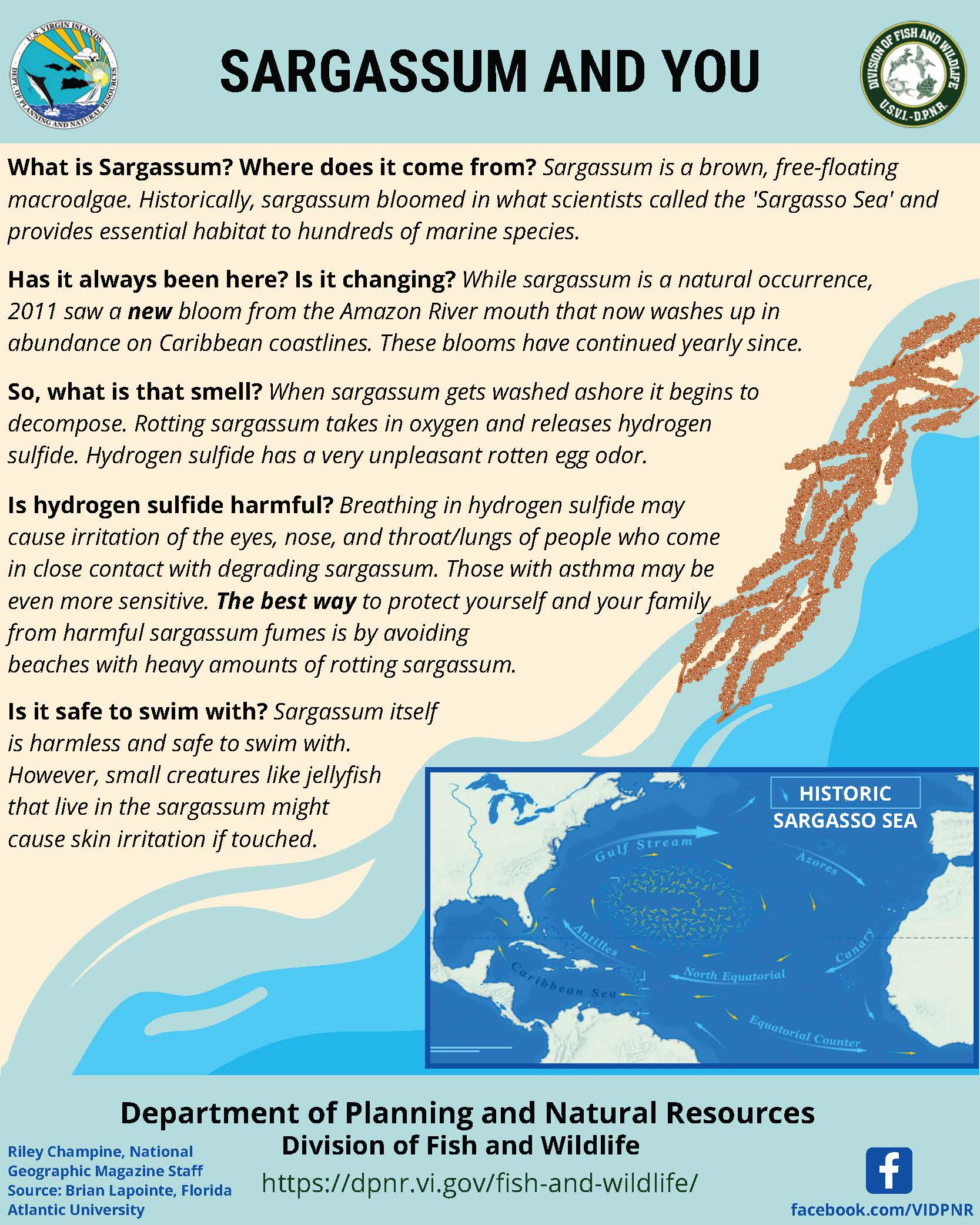
Sargassum is a type of brown, free-floating macroalgae that historically proliferated in the Sargasso Sea, where it supports a diverse array of marine life. However, since 2011, a new bloom originating near the mouth of the Amazon River has resulted in recurrent, large-scale accumulations along Caribbean coastlines. Once washed ashore, decomposing sargassum releases hydrogen sulfide, producing a strong “rotten egg” odor and causing eye, nose, throat, and respiratory irritation, particularly for individuals with asthma. Avoiding beaches with large amounts of decaying sargassum is the best method of prevention.
While sargassum in the water is not harmful to swimmers, marine organisms such as jellyfish that inhabit the algae can cause skin irritation upon contact. It may also pose risks to motorized vessels, as large clumps can become tangled in propellers. If this occurs, boat operators are advised to place the motor in reverse to clear the obstruction.
Manual removal by hand or with rakes is permitted for small-scale nuisance sargassum that cannot be avoided. In more severe situations, beachfront businesses may apply for permits through DFW and the Division of Coastal Zone Management to use mechanical equipment for removal. Deployment of containment booms requires a permit from the Army Corps of Engineers. DFW also provides required training to ensure removal efforts follow ecological best practices and comply with Virgin Islands Code.
DPNR will continue issuing these monthly updates via press release. For more information, visit dpnr.vi.gov or contact Division of Fish and Wildlife on St. Croix: (340) 773-1082 or on St. Thomas: at (340) 775-6762 or Email: DFWElectronic@usvi.onmicrosoft.com.