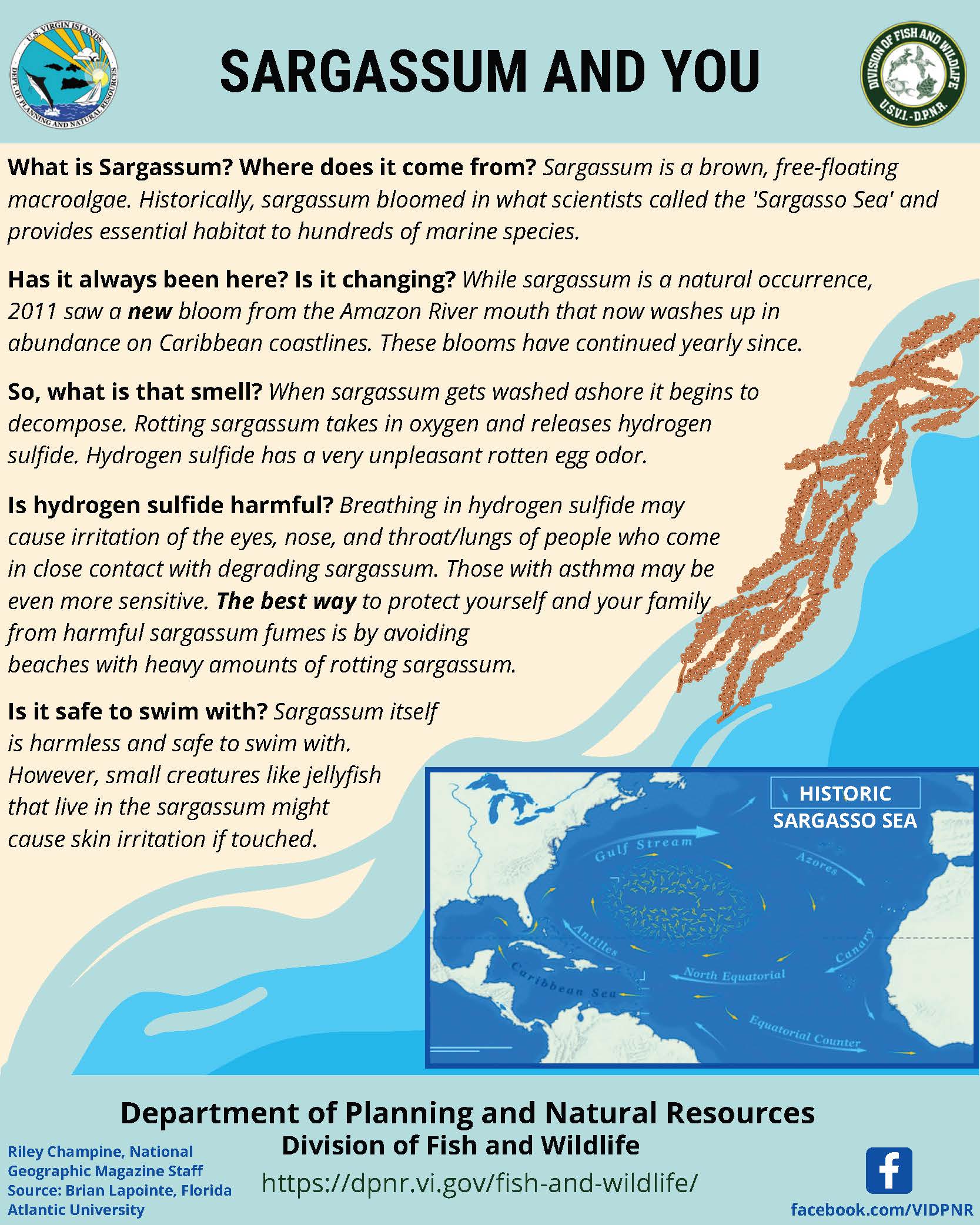
As sargassum clumps and mats continue to move into the territory, Commissioner of the Department of Planning and Natural Resources (DPNR) Jean-Pierre L. Oriol on behalf of the Division of Fish and Wildlife (DFW) reminds the public of steps they can take to protect themselves in what is predicted to be a record high year for accumulation at the territory’s beaches.
“When the brown, free-floating algae reaches the shore and begins to decompose, it releases hydrogen sulfide, which produces a strong ‘rotten egg’ odor and causes eye, nose, throat, and respiratory irritation, particularly for individuals with asthma,” Oriol said. “Avoiding beaches with large amounts of decaying sargassum is the best method of prevention.”
Beachfront businesses facing large amounts of nuisance sargassum are also invited to request authorization for mechanical removal from the Divisions of Fish & Wildlife and Coastal Zone Management. Deployment of containment booms requires a permit from the Army Corps of Engineers. DFW also provides required training to ensure removal efforts follow ecological best practices and comply with Virgin Islands Code.
“The trend in the last few months has continued, resulting in increased Sargassum amounts in every region shown on the map. Nearly every region also continued to see record-high Sargassum amount for the month of April,” according to a lab report released on April 30 by the University of South Florida College of Marine Science’s Optical Oceanography Lab. The lab has collaborated with DPNR-DFW, the University of South Florida, and regional partners through support from the National Oceanic and Atmospheric Administration’s Monitoring and Event Response for Harmful Algal Blooms Research Program at https://coastalscience.noaa.gov/project/developing-an-operational-sargassum-hab-monitoring-and-forecasting-system-for-the-southeastern-u-s-and-u-s-caribbean/.
Daily reports can be viewed through NOAA’s Sargassum Inundation Risk (SIR) tool has been updated to provide daily reports, thanks to this partnership as part of CoastWatch at https://cwcgom.aoml.noaa.gov/SIR/.
DPNR will continue issuing these monthly updates via press release.