Commissioner Jean-Pierre L. Oriol of the Department of Planning and Natural Resources (DPNR), on behalf of the Division of Fish and Wildlife (DFW), is advising the public to prepare for another year of record sargassum influx as concentrations continue to rise across the Caribbean, consistent with early 2026 forecasts.
These projections are based on assessments from the University of South Florida’s College of Marine Science Optical Oceanography Lab. The monitoring system was developed in collaboration with DPNR-DFW, the University of South Florida, and regional partners, with support from the National Oceanic and Atmospheric Administration’s Monitoring and Event Response for Harmful Algal Blooms Program. More information is available at:
https://coastalscience.noaa.gov/project/developing-an-operational-sargassum-hab-monitoring-and-forecasting-system-for-the-southeastern-u-s-and-u-s-caribbean/.
A bulletin released February 28, 2026, reports that sargassum levels in the Western Caribbean and Western Atlantic remain at record highs. The lab noted an increase in Caribbean sargassum from 0.45 million tons in December 2025 to 1.7 million tons in January 2026—more than tripling within four weeks. Additional details can be found at the Optical Oceanography Laboratory’s website.
According to the lab, three major sargassum masses are currently present in the Eastern Atlantic, Western Atlantic, and Caribbean. Both the Caribbean and Western Atlantic regions recorded “record-high” sargassum levels in January, exceeding 75 percent of historical measurements.
“Sargassum amount in most regions is set to increase in the coming month,” the bulletin states. “Because of the continuous growth from November to February and because of record-high amounts in most regions, 2026 is set to be another major sargassum year.”
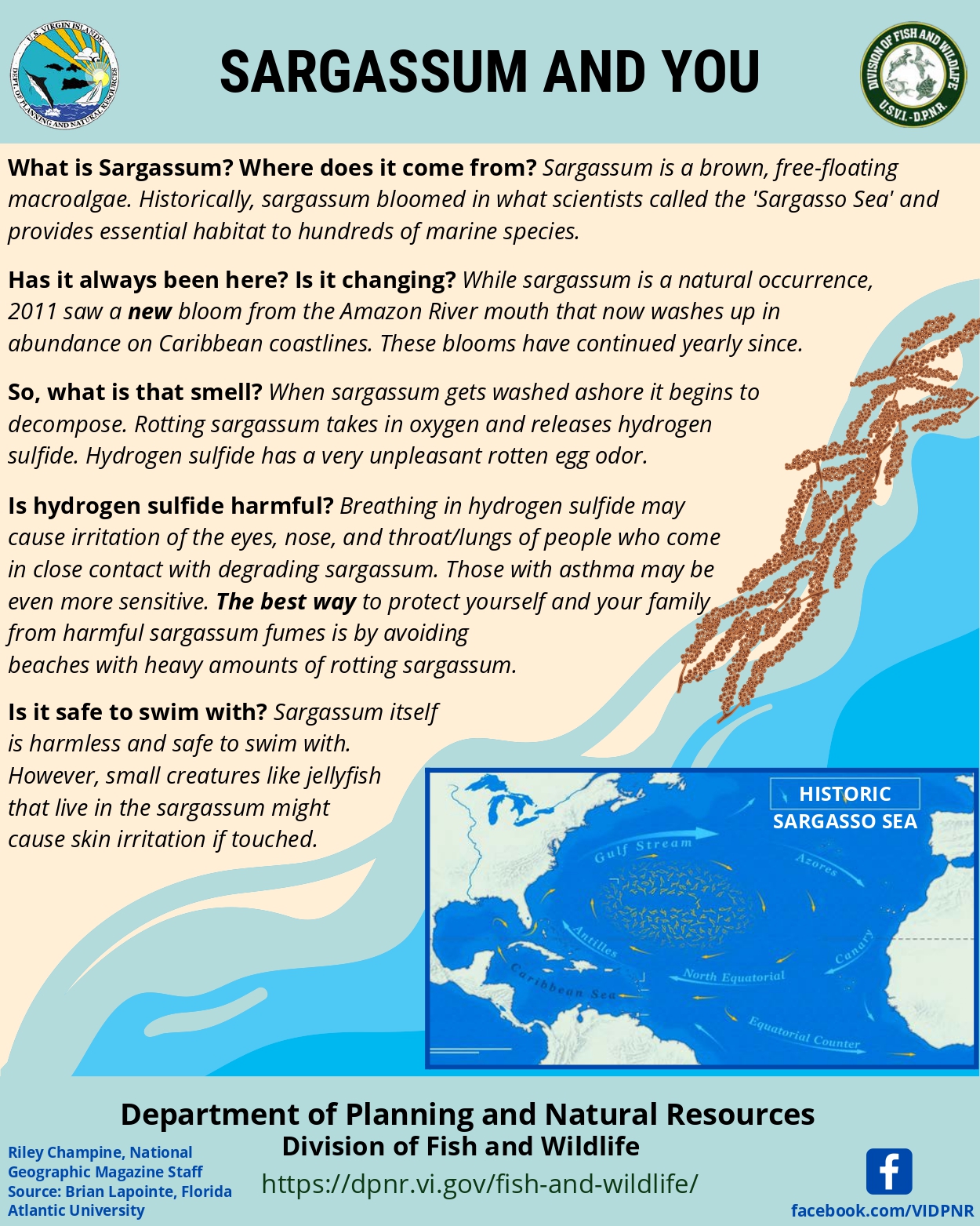
Sargassum is a brown, free-floating macroalgae that naturally thrives in the Sargasso Sea and supports a variety of marine organisms. Since 2011, however, a second bloom originating near the Amazon River has caused repeated large-scale accumulations throughout the Caribbean. When beached, decomposing sargassum releases hydrogen sulfide, producing a strong “rotten egg” odor and causing irritation to the eyes, nose, throat, and respiratory system—effects that are more severe for individuals with asthma. Avoiding beaches with significant decaying sargassum is the most effective precaution.
While sargassum in the water does not harm swimmers, marine species such as jellyfish that inhabit the algae can cause skin irritation. Large patches of sargassum can also interfere with motorized vessels by entangling propellers. If this occurs, boat operators are advised to shift the engine into reverse to clear the obstruction.
Small quantities of nuisance sargassum may be removed manually by hand or with rakes. For larger accumulations, beachfront businesses may apply for permits from DFW and the Division of Coastal Zone Management to use mechanical equipment. The deployment of containment booms requires authorization from the U.S. Army Corps of Engineers. DFW also provides mandatory training to ensure removal activities follow ecological best practices and comply with Virgin Islands Code.
For more information, visit dpnr.vi.gov or contact the Division of Fish and Wildlife:
- St. Croix: (340) 773-1082
- St. Thomas: (340) 775-6762
- Email: DFWElectronic@usvi.onmicrosoft.com